Robert Mitchum
(For optimum viewing, adjust the zoom level of your browser to 125%.)
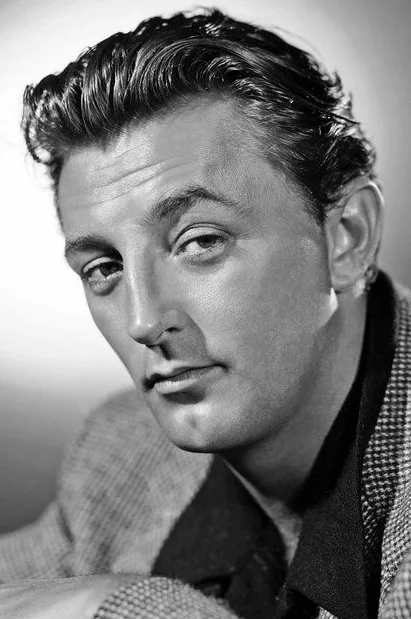 Last Updated: 8/15/26
Real Name: Robert Charles Durman Mitchum
Born: August 6, 1917
Died: July 1, 1997 (Aged 79)
Height: 6' 0"
Grade: A+
Actor/Movie Star: 50%-50%
Prime Years: 1944-70, 1973-76, and 1982-83
Most Famous Film: Cape Fear (1962)
Most Infamous Film: The Big Sleep (1978)
Masterpiece: Out of the Past (1947), Heaven Knows, Mr. Allison (1957),
Cape Fear (1962), Farewell, My Lovely (1975), and That Championship Season (1982)
Outstanding: Where Danger Lives (1950), The Lusty Men (1952),
Man with the Gun (1955), The Enemy Below (1957), The Hunters (1958),
Man in the Middle (1964), and The Winds of War (1983)
Honorable: His Kind of Woman (1951), Angel Face (1952), and Thunder Road (1958)
Opinion:
I have to admit not being a fan of Robert Mitchum's work from the outset because of his lazy acting. Yet the
more films I watched, the slower I came to appreciate his laconic, easygoing style. There's also intelligence
behind his sleepy eyes that's readily evident in military films such as The Enemy Below, The Hunters,
Man in the Middle, and The Winds of War. On the topic of film noir, I quickly think of three
giants: Humphrey Bogart, Robert Mitchum, and Burt Lancaster; each has a different approach, and they're all
wonderful. People have their own favorite Robert Mitchum film, and mine will always be
Farewell, My Lovely, proving that nobody could play Philip Marlowe better. Most of all, Robert Mitchum
came first way before Marlon Brando, Montgomery Clift, and James Dean. Famous for his "don't give a
fuck" attitude, I believe he secretly cared about acting and making quality films as well.
Confirmed:
Of Scotch, Irish, and Norweigan ancestry with Blackfoot Indian blood, was born in Bridgeport, Connecticut, with a
dimple in his chin. Inherited maternal grandfather's build: broad shoulders, barrel chest, slim legs and
strong legs. Had a brother named John who became an actor. A former soldier, father worked for the railroad and
died from internal injuries after being trapped between the couplings of two freight cars when Robert Mitchum
was 18 months old. Mother drifted around until becoming linotype operator at a newspaper company.
Became a voracious reader at age 4, thanks to his mother, surprising everybody until his death that he actually
read so many books. Cited Joseph Conrad, Eugene O'Neill, William Wordsworth, Thomas Wolfe, and Aldous Huxley
as favorite authors. Because of his sister's ambitions to be on the stage, was influenced to do the same at
age 6 but quickly gave up and began to focus on being a writer, especially in poetry and songs. Had his works
published in a newspaper, resulting in local fame. Moved around a lot and was constantly in trouble, sometimes
for the wrong reasons. Developed an antisocial attitude and was considered to be a deep loner. Showed no
interest in sports and had barely no education. Got expelled in high school for a prank and was forced to
look for work in 1931.
Decided to become a hobo by riding trains and was arrested in Savannah, Georgia, on a vagrancy charge in 1933,
having been sentenced to a chain gang for seven days. Escaped from there one night and developed gangrene on
his leg which was cured by going back to home in Rising Sun, Delaware. Worked on hundreds of menial jobs all
over the country while getting in trouble with the law. Moved to Southern California with his family in 1935
and started to smoke weed the following year. Boxed for a while.
Caught the bug of performing by singing for a contest through radio in 1936. On the advice of his sister, was
encouraged to join the Players Guild of Long Beach and won a role in a play by 1937 [while there, worked
with Gloria Grahame whose older sister would marry his brother John]. By all accounts, took no
acting lessons and was a total natural, causing his rapid ascent in theatrical plays while writing material for
different mediums. Became a factory worker at Lockheed during WWII, having worked with James Dougherty who would
marry Norma Jeane Baker, the future Marilyn Monroe [Robert Mitchum had famously claimed that he socialized
with her but, in fact, had never met her once]. Received a deferment after being classified as 1-A for WWII
because of his family plus marriage including a son who would be an actor: James who's a dead ringer for his
father. But did serve in the Army for eight months due to an alternative offer after receiving a 180-day
sentence for a domestice disturbance.
Hated his job at Lockheed so much that he quit to appear as an extra in movies due to manpower shortage.
Made a breakthrough in 1942 after thumbing for a ride and getting picked up by the daughter of the writer of the
Hopalong Cassidy series. Appeared in 26 total films the next two years and was Oscar-nominated for the
first and only time of his career for his performance in Story of G.I. Joe. Thanks to Mervyn LeRoy
and MGM failing to pick up the option after Thirty Seconds Over Tokyo, RKO became persuaded enough to
sign Robert Mitchum for a seven-year contract which began his run as noir legend in 1947 and eventually the
studio's biggest star. However, was persuaded to change his name to "Robert Marshall" but refused to acquiesce.
Was infamously busted in a narcotics raid on September 1, 1948, along with Lila Leeds, an aspiring actress who's
best known for Lady in the Lake, and a couple of others. At the time, thought he
was done for good (during arrest, was asked by cops what he did for a living and said, "Former
actor") but suprisingly saw his profile climb higher as the bad boy of Hollywood, resulting in
box-office hits, but Lila Leeds was absolutely through. When asked about his experience in jail, "it's like
Palm Springs—without the riffraff." Afterwards, started to shape up and maintained respectability
for years. Knocked out Bernie Reynolds, a top ten heavyweight boxer, at a bar in 1951.
At the 1954 Cannes Film Festival, made headlines around the world by covering up the topless Simone Silva.
During the same year, ended his association with RKO permanently, allowing himself to become a freelance
actor. After the making of The Night of the Hunter, a libelous story came out in Confidential
that Robert Mitchum showed up at Charles Laughton's house naked and poured ketchup all over his body,
causing the actor, the first ever to do so, to file a lawsuit against the magazine which, in turn, went
bankrupt after more thespians proceeded in the same manner.
Recorded a calypso album in 1957. Performed all of his stunts in Heaven Knows, Mr. Allison and was
privately disappointed that the Academy failed to recognize him for Best Actor. Had a hand in
Thunder Road by coming up with a script idea and oversaw its production, leading to a surprise hit in
the South, and would record the music. Gave one of the greatest performances of his career as Max Cady in
Cape Fear, ironically terrorizing Polly Bergen's character who would end up being his wife in
The Winds of War.
Made a musical recording in 1967 that topped number one in some markets across the country. Went to the Vietnam
War for morale support. Was asked to take on the leading role for Patton but said no and suggested George
C. Scott who ended up winning the Oscar. Met Christy Brown (of future My Left Foot) in Ireland during the
filming of Ryan's Daughter, having drinks with him and wheeled him around.
Changed his mind about appearing in TV when he agreed to be involved with The Winds of War, the most
significant work of his career which would be topped by War and Remembrance. Starting in 1982,
displayed offensive behavior that turned off many people. In an article that bizarrely ruined his reputation,
reeled off anti-Semitic and racist remarks and denied the Holocaust happened. Got sued for throwing a basketball
in the face of a female photographer and had to settle the case.
Was nicknamed "Bob" by everybody. Suffered from claustophobia. Was a habitual liar and liked to tell fanciful
stories. Drank heavily, smoked pot, and fought people in bars. Possessed a photographic memory which was acquired
from his mother. A very light sleeper, could manage only four hours per night and suffered from insomnia. Hated
authority. Despite being loyal to his wife (they met when he was 16 and she 14 and stayed married for 57 years),
cheated on her consistently but remained a family man.
Didn't treat acting as "central to his being." Rated Deborah Kerr, Jane Greer, and Sarah Miles as his favorite
co-stars. Just about everybody was surprised and impressed by his professionalism while working with him.
Had been described "extremely intelligent" by everybody from childhood to old age. Could play the sax and loved
to fish. A lifelong heavy smoker, died of complications from lung cancer and emphysema, just one day before
James Stewart passed away which wiped out the memory of his death nationally.
Once said: "There are too many pastel people—pastel characters—in Hollywood. They don't know how to
portray a character. Some of them are just busy little people studying their lines. If they learned more about
life, about people, about psychology, about acting and timing, their characterizations would be more believable,
more truthful, easier to take."
Rumors: None.