On G List of Movie Reviews
(For optimum viewing, adjust the zoom level of your browser to 125%.)
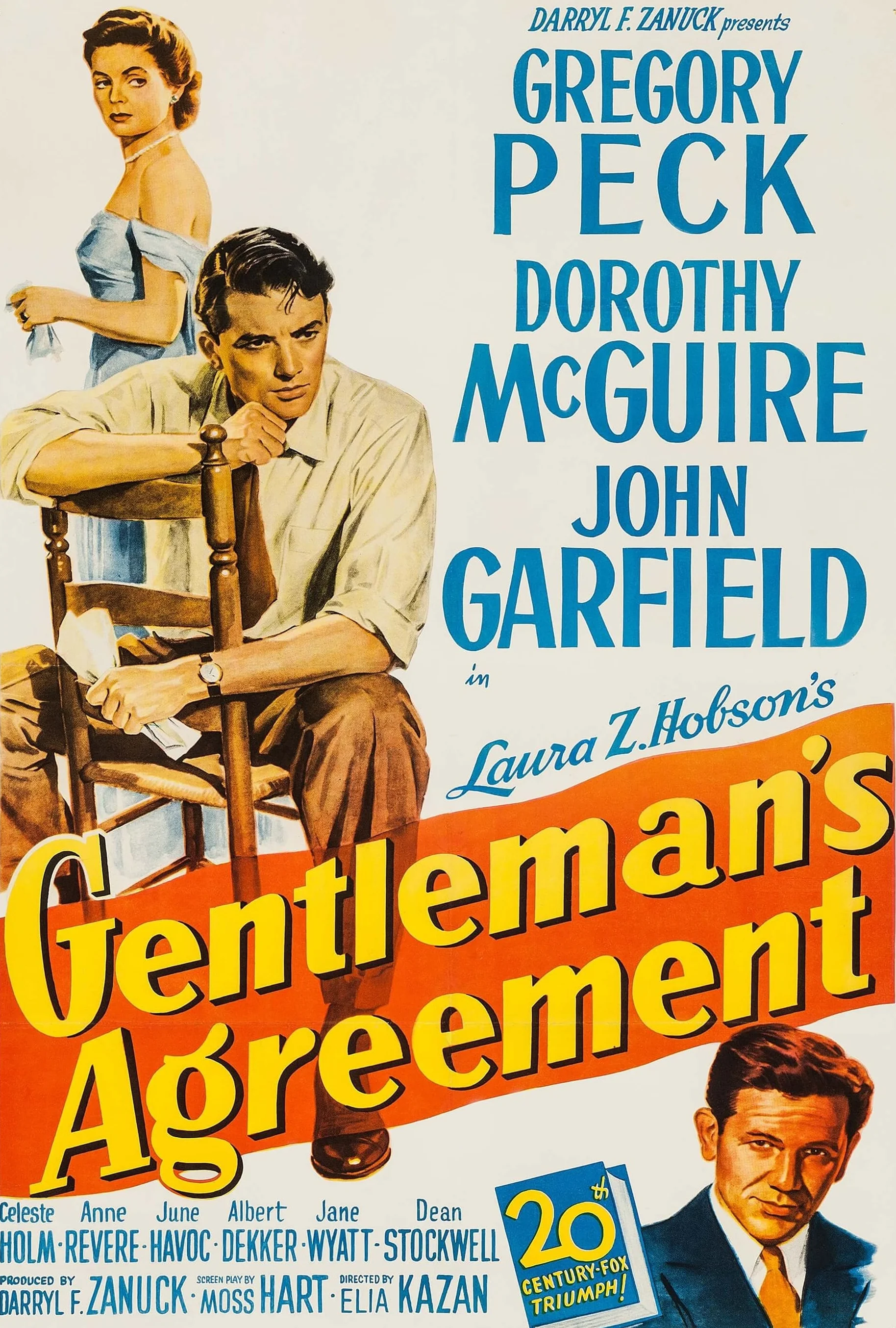
Gentleman's Agreement (1947)
Rate:
6
Viewed:
7/17
7/17:
I won't go so far as to say that Gentleman's Agreement, which is one of the first two films to deal
with anti-semitism with the other being Crossfire, is an overrated Best
Picture Oscar winner because it's not.
But to think of it as Best Picture material is laughable. It's just not a great movie. Part of the reason why
is how poorly structured the plot is. I was ready to give it a '3' after sitting through the first hour of
dated, soapy melodrama.
For a good deal of time, Phil Green was telling some people about his plan and then asked them all to keep it
under wraps. Therefore, the open secret became the film's running joke. I got lost when trying to figure out
which role Green was supposed to take on. Then, things completely changed when John Garfield first showed up.
From there on, the movie wasn't the same anymore. The second half is one of the most moving stuff I've felt
in a while, being reminded of the themes touched on in
The Heart Is a Lonely Hunter and
Easy Rider. In short, it's powerful stuff.
Four thespians were Oscar-nominated for their performances, but none of them were named John Garfield! What a
shock. A true force of nature, he's the single biggest reason why the message works. He's authentic and plays
an authentic character. It's what he went through in real life. Everybody else is fake. Hence, John Garfield
should've been Oscar-nominated.
Whenever John Garfield appears, everybody, most notably Gregory Peck who wasn't mature enough to handle this
kind of role, pales in comparison to him. They're two or three levels below where he's at. It's overall a bad
mismatch. Only Celeste Holm stands out and gives a timeless performance, but her role doesn't have much to do
with the main theme. Pointless for the most part, she plays a freewheeling, gay character.
The focus should've been on the writer's determination in getting to the truth. Unfortunately, the wrecked plot
structure hinders Gregory Peck's progress as he was taking so long to get there and wasn't making much headway
until John Garfield's character showed up. When he did, the purpose finally became crystal clear.
In the meantime, the whole thing between Phil Green and his new girlfriend, Kathy Lacy, is a filler, wasting a
lot of my time. I've lost interest in their talks, lovemaking sessions, and going back-and-forth about their
feelings. Eventually, I couldn't care about their relationship, but when it felt important, I was earnestly
rooting for Phil to go for Celeste Holm's character because Kathy was a hypocrite who lived in a bubble.
Anyway, the real reason why I picked up Gentleman's Agreement is that I read a nonfiction book which
mentioned Darien, Connecticut, and that it was a notorious sundown town, having kept out African American and
Jewish families for decades. Nothing about it has changed to this day. On the other hand, it's a strange movie
for entirely different reasons. Elia Kazan metaphorically talks about facing issues head-on by not being silent
about them when pressed. Yet, in 1952, he gave the names of eight actors to the House Un-American Activities
Committee (HUAC). Two years later, Kazan directed On the Waterfront
as a veiled way to justify his decision. Basically, his career was built on the ruin of other people's careers,
yet he remained an influential director, paving the way for future Method actors.
As for John Garfield, the whole HUAC matter stressed him out so much that he was fatally struck by a heart
attack at the age of 39 the night before he was scheduled to appear at the hearing for the second time after
being placed in the blacklist for one year. What a sad loss of a fine actor who had so much more to give. Anne
Revere was also forced to appear before the HUAC but refused to and was therefore blacklisted, effectively ending
her career.
Notice when Dave Goldberg was narrating a story, he finished it off with "Somebody said, 'Give me a hand with
this sheeny.' Those were the last words he ever heard." "Sheeny" is a vulgar word for Jew. While watching
Gentleman's Agreement, I looked for Dean Stockwell but didn't spot him. So, I was like, "Where the
heck is he?" and went on the internet. It turns out he's the boy after all. Call me stupid, but I never realized
Dean Stockwell started out as a child star.
All in all, I wish Elia Kazan did a better job with the plot structure for Gentleman's Agreement to make
it more even-keeled.